Data centres · Self-delivery · Quality · Safety
How Maveric Approaches Data Centre Construction Standards
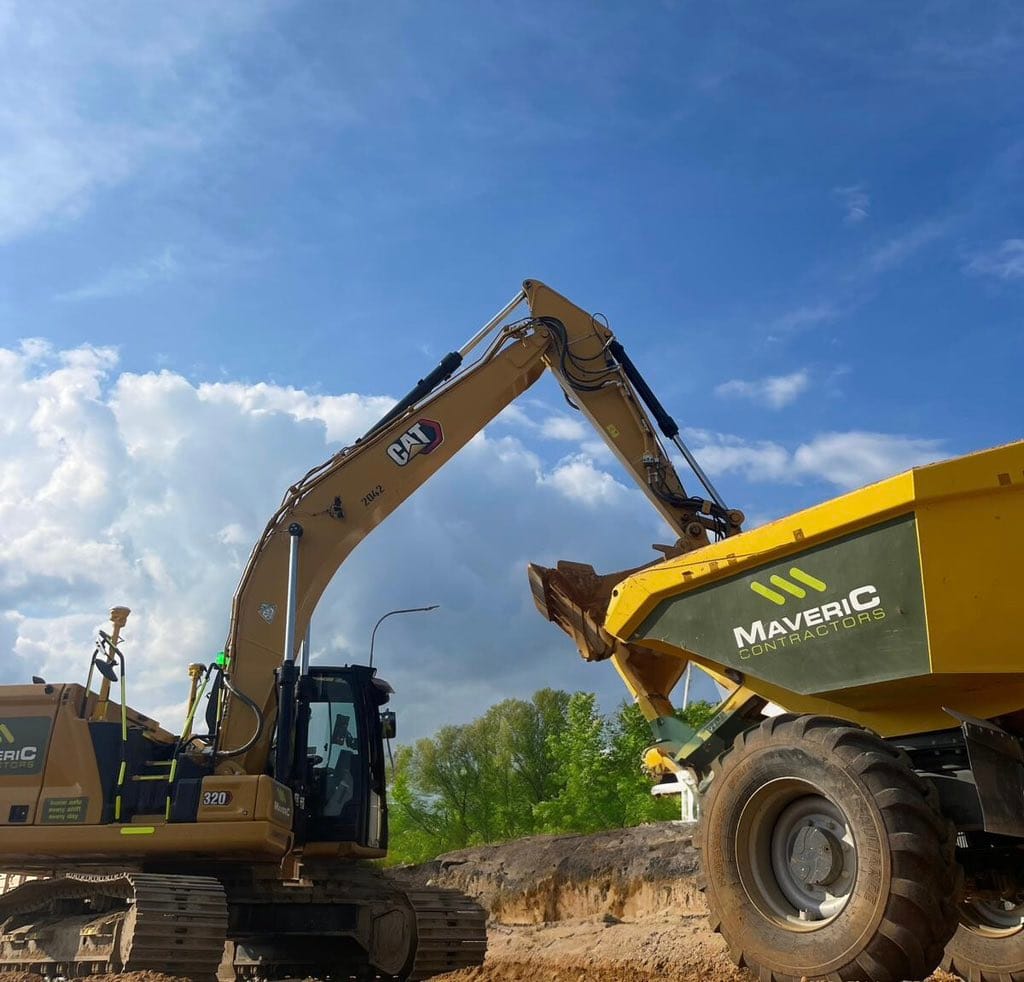
Data centres are among the most demanding civil projects in Europe. Programmes are compressed, tolerances are tight, sites are live, and the ground beneath the slab has to be right before any of the rooms above it are commissioned. Meeting data centre construction standards on work like this is not a single act of certification. It is a way of working, held steady across every shift, every package and every market.
Maveric is an independent European civil engineering contractor delivering the civil, structural and enabling works that sit underneath a hyperscale or colocation campus. This piece sets out how we approach that work: self-delivery with our own crews and plant, an in-house digital backbone that records what was built, and management systems aligned to ISO 45001, ISO 14001 and ISO 9001. The aim is the same wherever we are on the ground, from Galway to Frankfurt to Oslo.
What data centre construction standards really mean
When clients and main contractors talk about standards on a data centre, they are rarely talking about one document. They mean the combination of things that have to hold true at the same time: a safe site, a buildable programme, ground and structures within tolerance, and a defensible record of how each was achieved. On mission-critical infrastructure, a quality lapse in the civils is expensive to unpick once the building is sealed and the equipment is in.
Data centre civil engineering carries particular weight here. The earthworks platforms, drainage networks, duct banks and reinforced foundations are largely buried or built over as the campus rises. They cannot be inspected casually later. That places the burden on getting the groundworks right the first time and proving it as the work proceeds, rather than relying on rework once a defect surfaces.
Self-delivery as the basis for quality
Maveric self-delivers. The crews on a data centre platform are Maveric crews, and the excavators, dozers and dewatering kit are Maveric plant. We do not subcontract the heavy groundworks and then manage the gaps between other people's labour. This is the single most important factor in how consistently we can hold a standard, because the people accountable for the result are the people doing the work.
Self-delivery removes the layers where information and responsibility usually leak. Method statements are written and owned in-house. Setting-out, compaction and concrete placement are carried out by teams who answer to the same management system. When a programme is compressed or a sequence changes around live areas, the response is a single coordinated decision, not a negotiation across a chain of subcontractors.
- Site establishment, enabling works and temporary works
- Bulk earthworks, dewatering and groundwater control
- Sheet piling, shoring and ground investigation
- Deep drainage, firewater and underground utility ducting
- Reinforced concrete, formwork and foundations
- High-voltage civils for on-site substations up to 400 kV
- External works and handover with a full digital record
An in-house digital backbone for traceability
Behind the crews sits MOS, Maveric's proprietary construction ERP, and a field-technology stack that feeds it. Project records, procurement, drawings, timesheets, inspections, observations and incidents live inside one system that Maveric built and operates. The point is not technology for its own sake. It is that the same evidence is captured the same way on every job, which is what makes a standard auditable rather than asserted.
The field tools support the same end. GPS machine control allows setting-out and grade to be worked to fine tolerances and verified against the design model. Ground-penetrating radar and vacuum (suction) excavation are used to locate and expose buried services safely, so digging near live infrastructure does not become a strike. Drone survey and photogrammetry feed BIM with measured progress, earthwork volumes and as-built records. By handover, the client receives a complete digital trail from mobilisation onward, not a box of paper assembled at the end.
Safety and environment built into the method
Data centre construction safety is inseparable from quality, because an unsafe sequence is almost always a poorly controlled one. Maveric runs to ISO 45001, with method statements and risk assessments signed off before a task begins and incidents, near-misses and observations logged and closed out digitally. The safety commitment is plainly stated: Home Safe. Every Shift. Every Day.
The same discipline extends to the environment under ISO 14001. Electric and hybrid plant is deployed where site power and regulation allow, mobile battery charging can replace diesel generators where the grid is absent, and fuel and carbon are tracked across the fleet and reported per site. In a sector where energy and embodied carbon are scrutinised closely, the civil works should not be a blind spot.
One standard across Ireland, Germany and Norway
Maveric operates through three entities under one Irish parent: Maveric Contractors Limited in Galway, founded in 2004; Maveric Bau GmbH, the continental delivery hub working from Frankfurt; and Maveric Entreprenør NUF, our Nordic capability based around Moss and Oslo. Data centre construction in Europe rarely sits inside a single jurisdiction, and a client should not have to relearn how a contractor works each time the map changes.
The model is local teams and plant in each market, run on one integrated management system aligned to ISO 9001, ISO 45001 and ISO 14001. Local regulation is respected in full; German sites, for example, are delivered against Baustellenverordnung, and every project is aligned to the supplier code of conduct of the relevant client. What stays constant is the way the work is planned, recorded and handed over, so the standard reads the same whether the campus is in Ireland, Germany or Norway.
Why the approach holds up under scrutiny
A standard is only as good as the evidence behind it. Because Maveric self-delivers and records the work through its own systems, the QA documentation, inspection and test plans, material testing and as-built records are generated as the build happens, package by package. There is a benchmark mock-up to inspect against, a dedicated QA manager in each operating company, and a defects close-out process that ends in an operational turnover backed by a complete record.
For a client or main contractor, that is the practical meaning of data centre construction quality: not a claim, but a chain of accountability from the first cleared metre of ground to handover. It is the same reason we are comfortable standing behind our commitments on safety, programme, cost and quality.
Frequently asked questions
What does self-delivery mean for data centre construction?
Self-delivery means Maveric carries out the civil works with its own crews and its own plant rather than subcontracting the labour. On a data centre, this keeps accountability for safety, programme and quality with the people actually doing the work, which makes standards easier to hold consistently.
Which civil works does Maveric carry out on a data centre campus?
Maveric self-delivers the full civil scope, including site establishment and enabling works, bulk earthworks, dewatering, deep drainage and underground utilities, reinforced concrete and foundations, high-voltage civils for on-site substations, and external works through to handover with a complete digital record.
How does Maveric ensure quality and traceability on data centre projects?
Work is recorded through MOS, Maveric's in-house construction ERP, alongside a field-technology stack covering GPS machine control, ground-penetrating radar, vacuum excavation, fleet telematics and drone survey feeding BIM. This produces an auditable digital trail from mobilisation to handover, captured the same way on every job.
What standards does Maveric work to?
Maveric is aligned to ISO 45001 for safety, ISO 14001 for the environment and ISO 9001 for quality, run inside one integrated management system across the group.
Where does Maveric deliver data centre civil engineering in Europe?
Maveric operates across Ireland, Germany and Norway through three entities under one Irish parent, based in Galway, Frankfurt and around Moss and Oslo. Local regulation is followed in each market while the way of working stays consistent.
How does Maveric keep crews safe when digging near live services?
Maveric uses ground-penetrating radar to locate buried services and vacuum (suction) excavation to expose them safely, supported by AI proximity detection on plant. This reduces the risk of a service strike and keeps the work aligned with its ISO 45001 safety system.