
Data centres · Civil engineering · Enabling works · Europe
Data Centre Construction in Europe: The Civil and Enabling Works Behind Every Campus
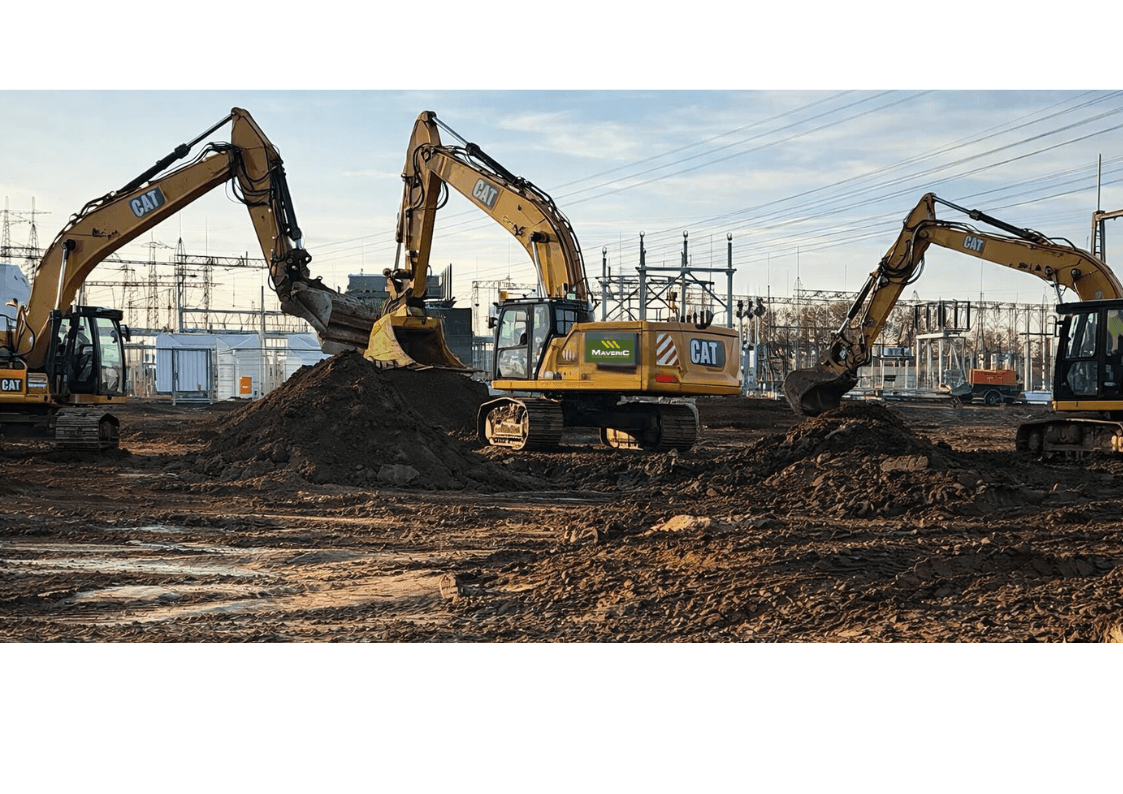
Every data hall begins below ground. Long before the structural steel and the mechanical and electrical fit-out arrive, a campus is decided by the quality of the civils beneath it — the level of the platform, the integrity of the drainage, the position of every duct. Data centre construction in Europe is, first and foremost, a civil engineering undertaking carried out to a tight programme on ground that is rarely as simple as the site investigation suggests.
This article sets out what the civil and enabling works actually involve, from the first machine onto a green field through to a handover-ready platform with a complete digital record. It is written for the clients, main contractors and design teams who carry the programme risk, and who need to know that the works under their buildings have been delivered properly the first time.
What data centre construction services cover below the building line
A data centre programme is a sequence of dependencies. The platform has to be right before foundations can start; the deep services have to be in before the slabs close them off; the high-voltage routes have to be coordinated before the structure boxes them out. The civil package is the discipline that holds that sequence together, and it spans far more than moving soil.
Across a typical campus, the civil and enabling scope includes:
- Site establishment and enabling works — access, hardstanding, welfare, hoarding and the temporary works that let every other trade start
- Bulk earthworks — cut and fill to formation, with material balanced and reused on site wherever ground conditions allow
- Dewatering and groundwater control to keep excavations stable and workable
- Sheet piling, shoring and ground improvement where excavations are deep or ground is poor
- Ground investigation, contaminated-soil handling and UXO survey and clearance before disturbance
- Deep drainage and underground utilities — foul, surface water, attenuation and the wet and dry services that feed the campus
- Reinforced concrete and formwork — foundations, slabs, plinths and the structural elements the buildings sit on
- High-voltage civils up to 400 kV — substation plinths, blast walls, earthing grids and duct banks
- External works, hard and soft landscaping, and handover with a full digital record
From mobilisation to handover: the sequence on a data centre construction site
The work starts with mobilisation and enabling — establishing safe access, setting out, and confirming the ground against the investigation data. Bulk earthworks then bring the site to formation level, with cut and fill balanced to minimise material leaving site. Dewatering, shoring and ground improvement run alongside where conditions demand them, keeping deep excavations safe and the programme intact.
With the platform stable, attention turns to the buried infrastructure — deep drainage, attenuation and the underground utility corridors that a data hall depends on. Reinforced-concrete foundations, slabs and plinths follow, and the high-voltage civils are built in parallel: duct banks, earthing and the substation and transformer bases that connect the campus to the grid. The final phase is external works, reinstatement and a structured handover, in which the as-built record is as important a deliverable as the concrete.
Each of those stages is a hold point for the next. Getting the early works right — the levels, the compaction, the duct positions — is what protects the structural and fit-out programme that follows.
Why self-delivery changes the programme risk
The single biggest variable on a data centre construction programme is control. Where the civil package is broken up and subcontracted, every interface becomes a place for the programme to slip and for accountability to blur. Self-delivery removes those interfaces. Maveric works with its own crews and its own plant, not subcontracted labour, so the organisation that prices the works is the one that builds them and stands behind them.
That control is reinforced by a digital backbone. An in-house construction ERP runs the commercial and programme data, while a field-technology stack supports the work in the ground: GPS and Trimble machine control for accurate earthworks, ground-penetrating radar and vacuum (suction) excavation for safe digging around live services, AI proximity detection for plant and people, fleet telematics, and drone survey with photogrammetry feeding the BIM model. Vacuum excavation here is a safe-dig method, not a hire line — one of the techniques that keeps crews clear of energised cables and pressurised mains.
The point of the technology is not novelty. It is a tighter, more auditable programme: fewer interfaces, fewer surprises, and a record that proves the works were built as designed.
One European operation across Ireland, Germany and Norway
Clients running data centre programmes across more than one market increasingly want a delivery partner that can follow the work across borders rather than re-procuring the civils in each country. Maveric is structured for exactly that — an independent European civil engineering contractor founded in Galway, Ireland in 2004, operating through three entities under one Irish parent.
Maveric Contractors Limited is the Irish business and group headquarters in Galway. Maveric Bau GmbH is the continental delivery hub, with operations and plant out of Frankfurt and registration in Tegernsee. Maveric Entreprenør NUF carries the Nordic capability from Moss and Oslo. Three countries, one operating model and one standard of work — so a client running parallel campuses in Ireland, Germany and Norway meets the same methods, the same digital backbone and the same line of accountability in each.
Safety, environment and quality as a baseline
Data centre sites are dense, congested and fast-moving, with live services, deep excavations and heavy lifts in close proximity. On a programme like that, safety and quality cannot be bolted on at the end — they have to be designed into the method. Maveric runs an integrated management system aligned to ISO 45001 for occupational health and safety, ISO 14001 for environmental management and ISO 9001 for quality, and its safety commitment is simple: Home Safe. Every Shift. Every Day.
Environmental performance is built into the same approach — balancing earthworks to reduce material movement, controlling groundwater and runoff, and handling contaminated soil correctly. The result is a civil package built to the standard mission-critical infrastructure demands, with performance evidenced in the record rather than asserted.
Frequently asked questions
What are enabling works in data centre construction?
Enabling works are the early activities that prepare a site for the main build — site establishment and access, ground investigation, earthworks to formation level, dewatering, shoring and the deep services. They set the platform and the sequence that the structural and fit-out works depend on.
What does data centre civils typically include?
Data centre civils cover bulk earthworks, dewatering and ground improvement, deep drainage and underground utilities, reinforced-concrete foundations, slabs and plinths, high-voltage civils such as duct banks and substation bases, and external works through to handover.
Why does self-delivery matter on a data centre construction programme?
Self-delivery means the civils are built by the contractor's own crews and plant rather than subcontracted out. That removes interfaces between parties, keeps accountability with one organisation, and gives tighter control over programme, quality and safety.
Which European markets does Maveric deliver data centre construction in?
Maveric operates across Ireland, Germany and Norway through three entities under one Irish parent — in Galway, in Frankfurt and Tegernsee, and in Moss and Oslo — delivering the same methods and standard of work in each market.
How is digging carried out safely around live services on a data centre site?
Safe digging around live and unknown services combines detection with non-mechanical excavation. Ground-penetrating radar locates buried utilities, and vacuum (suction) excavation removes soil without striking cables or pipes, keeping crews clear of energised or pressurised services.
What certifications should a data centre civils contractor hold?
For mission-critical work, look for management systems aligned to ISO 45001 for safety, ISO 14001 for environmental management and ISO 9001 for quality. Maveric aligns its management systems to all three, with safety and quality designed into its method rather than added afterwards.