Construction Ireland · Data Centres · Civil Engineering · Dublin
Construction Company in Dublin: Civil Engineering for Ireland's Critical Infrastructure
Few places in Europe carry the weight of digital and energy infrastructure that Dublin does. The capital and its surrounding counties have become a centre of gravity for data centres, the high-voltage grid that feeds them, and the battery and renewable assets being built to balance the system. Choosing the right construction company in Dublin for that kind of work is no longer a question of who can clear a site — it is a question of who can engineer the ground, the structures and the buried services that mission-critical facilities depend on.
This article looks at what civil contractors actually deliver on these sites, why self-delivery matters when programmes are tight and tolerances are unforgiving, and how a contractor rooted in Galway works across Ireland and into continental Europe. Maveric is an independent European civil engineering contractor, founded in Galway in 2004, working in Ireland, Germany and Norway.
Why Dublin became a hub for critical-infrastructure construction
Dublin brings together three things data-centre and energy developers need at once: connectivity, a stable operating environment, and a deep base of construction companies in Ireland capable of building to international standards. The result is a sustained build-out of hyperscale and colocation campuses across the Greater Dublin Area, supported by the substation, grid-connection and energy-storage projects that make those campuses possible.
That concentration changes what is asked of a contractor. These are not standalone buildings; they are connected systems. A data-centre campus needs the platform earthworks, the deep drainage, the electrical and telecoms duct banks, and the high-voltage civils that tie it back to the network. The energy projects around it — substations, grid-route connections and battery storage — call on the same civil engineering. The contractors who succeed here are those who can hold all of that scope together.
What a civil construction company in Dublin actually delivers
Behind every critical-infrastructure facility is a civil package that runs from a cleared site to handover-ready ground. On a typical data-centre, substation or energy project, that scope is broad and sequenced, each element setting up the one that follows. It is the part of the job that is mostly invisible once the doors are open, and the part that is most expensive to get wrong.
Maveric self-delivers the full civil scope across these sites, including:
- Site establishment, welfare, enabling works and temporary works
- Bulk earthworks, ground stabilisation and engineered platforms
- Dewatering and groundwater control, plus contaminated-soil handling
- Ground investigation, and UXO survey and removal where required
- Sheet piling, shoring and excavation support
- Deep drainage, firewater mains and underground utilities
- HV, MV and LV electrical ducting and telecoms duct banks
- Reinforced concrete, formwork and structural foundations
- High-voltage civils up to 400 kV — transformer plinths, blast walls, earthing and duct banks
- Heavy lifts, precast concrete, external works and digital handover records
Self-delivery: own crews, own plant, one standard
The clearest dividing line between construction companies in Dublin is how the work actually gets done. A great deal of civil work is subcontracted out in layers, which spreads accountability thin and makes safety, quality and programme harder to hold to a single standard. Maveric works the other way: its own crews and its own plant carry out the civils, enabling works, logistics and temporary works directly.
Self-delivery is what lets a contractor stand behind its commitments on safety, quality, programme and cost. When the people on the machine and the people writing the method statement belong to the same organisation, decisions are faster and the audit trail is cleaner. On a live data-centre or energised substation, that control is the difference between a programme that holds and one that slips.
Technology and safety on the modern Dublin construction site
The civils on a critical-infrastructure site increasingly run on a digital and machine-control backbone, and a self-delivery contractor owns that capability rather than hiring it in. Maveric runs its work through MOS, a proprietary construction ERP, supported by a field-technology stack used as standard.
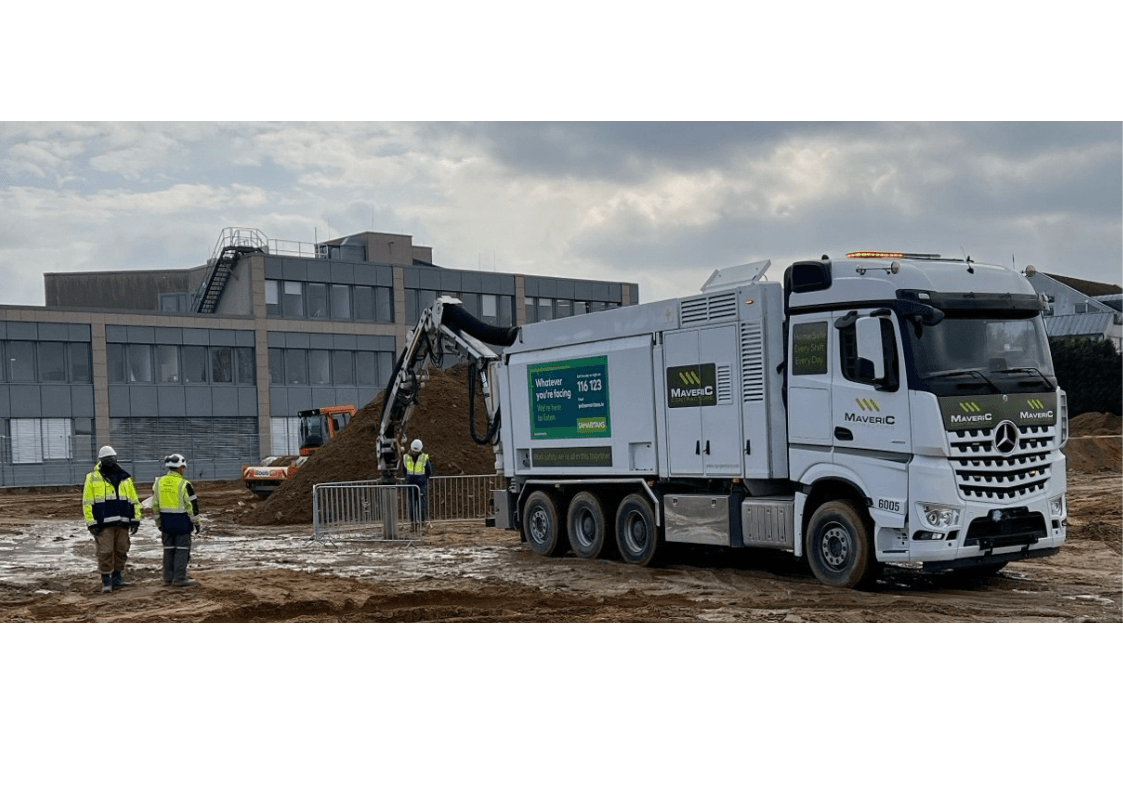
In practice that means GPS and Trimble machine control for millimetre-accurate setting-out, ground-penetrating radar and vacuum (suction) excavation to find and expose live services without striking them, AI proximity detection that stops plant before contact, fleet telematics, and drone survey with photogrammetry feeding BIM. Vacuum excavation here is a safe-dig method for working around live services — not a hire line — and it is one reason crews are kept out of the trench. All of it sits under a single safety commitment: Home Safe. Every Shift. Every Day.
Maveric runs one integrated management system — aligned to ISO 45001 for safety, ISO 14001 for environment and ISO 9001 for quality — audited through the same digital backbone that records the build.
Galway-rooted, working across Ireland and Europe
Being headquartered in Galway is a base, not a limit on geography. Maveric Contractors Limited, the Irish parent founded in 2004, anchors a group that delivers nationally across Ireland and into continental Europe. For clients, the civil engineering capability available in Dublin is the same capability available wherever the work is, backed by the depth of a European operation.
That reach is structured through three operating entities under one Irish parent: Maveric Contractors Limited in Ireland, Maveric Bau GmbH in Germany — the continental delivery hub, with operations and plant in Frankfurt — and Maveric Entreprenør NUF in Norway, the group's Nordic capability. Few construction companies in Galway and Dublin carry a delivery footprint of that span, and it matters for clients building similar facilities in more than one market: one contractor, one way of working, one set of standards.
For a developer or main contractor planning a data centre, substation or energy project, the practical upshot is continuity. The same civil engineering services, the same self-delivery model and the same digital handover record apply whether the site is in the Greater Dublin Area or on the Continent.
Choosing a construction company in Dublin for mission-critical work
For mission-critical infrastructure, the selection criteria are sharper than price and availability. The questions worth asking of any civil engineering contractor are practical and verifiable.
- Do they self-deliver the civils, or subcontract them out in layers?
- Can they carry the full scope — earthworks, deep services, structural concrete and HV civils — under one contract?
- Are their management systems aligned to ISO 45001, 14001 and 9001, and audited against them?
- Can they work safely inside live, energised or occupied environments?
- Do they hand over a complete digital record of what was built and what was buried?
- Can they deliver the same standard across multiple sites and markets?
Frequently asked questions
What does a civil engineering construction company in Dublin do?
It delivers the civil and enabling works beneath a building or facility — site establishment, earthworks, dewatering, deep drainage and utilities, reinforced concrete foundations, and high-voltage civils. On Dublin's data-centre and energy projects this is the groundwork that connects a facility to power, water, drainage and the grid.
Does Maveric only work in Dublin?
No. Maveric is headquartered in Galway and works nationally across Ireland, as well as in Germany and Norway through its three operating entities under one Irish parent. The same self-delivery model and standards apply wherever the work is.
What is self-delivery, and why does it matter?
Self-delivery means the contractor uses its own crews and its own plant rather than subcontracting the work out. It keeps accountability for safety, quality, programme and cost inside one organisation, which is particularly important on mission-critical sites where tolerances and timelines are unforgiving.
What sectors does Maveric build for in Ireland?
Data centres, substations and grid infrastructure, battery energy storage (BESS), renewables and semiconductor facilities. The civil engineering scope is broadly common across all five, which is why one contractor can serve them all.
Does Maveric work to recognised standards?
Yes. Maveric runs one integrated management system aligned to ISO 45001 for occupational health and safety, ISO 14001 for environmental management and ISO 9001 for quality, audited through its in-house digital backbone.
How long has Maveric operated in Ireland?
Maveric Contractors Limited was founded in Galway in 2004 and is the parent and headquarters of the wider European group.