Building contractors · Civil engineering · Procurement · Critical infrastructure
What a Building Contractor in Ireland Does — and How to Appoint the Right One
Appointing a building contractor in Ireland sounds straightforward until you start comparing firms. One company builds housing estates, another lays the deep services and foundations beneath a data centre, a third only erects steel frames. They all describe themselves as contractors, yet the work, the risk they carry and the way they price are entirely different.
For industrial and critical-infrastructure projects — data centres, substations, battery storage, renewables and semiconductor facilities — the distinctions matter even more, because the ground, the programme and the safety case are unforgiving. This guide explains what a building contractor in Ireland actually does, how the main types of contractor differ, and what to look for when you appoint one.
Maveric is an independent European civil engineering contractor, founded in Galway in 2004, delivering civil, structural and enabling works for mission-critical infrastructure across Ireland, Germany and Norway. We write this as a self-delivering contractor, and the perspective below reflects that.
What a building contractor in Ireland does
A building contractor takes responsibility for turning a design into a completed, functioning facility. In practice that means planning and sequencing the works, mobilising labour, plant and materials, managing health, safety and environmental compliance on site, coordinating any specialist trades, controlling quality and cost against the programme, and handing the finished works over with a complete record of what was built.
On an industrial project the contractor's remit usually runs from a bare or cleared site through to a structure that is ready for the next stage of fit-out or commissioning. That early scope — the part that decides whether everything after it runs to programme — is where a great deal of the risk sits.
The work a building contractor in Ireland is expected to carry typically includes the following.
- Site establishment and enabling works — welfare, access, security and temporary services
- Bulk earthworks, ground investigation and groundwater control
- Deep drainage and underground utilities
- Reinforced concrete, foundations and structural works
- Coordination of specialist subcontractors and statutory bodies
- Health, safety, quality and environmental management throughout
- Handover with as-built records and a verifiable quality trail
Main contractor, civil engineering contractor or specialist subcontractor?
The three terms are often used loosely, but they describe different roles on a project.
A main contractor holds the overarching contract with the client and is accountable for delivering the whole works. Main contractors frequently manage and coordinate rather than self-perform, subcontracting most trades and overseeing the programme, commercial position and safety across all of them.
A civil engineering contractor delivers the civil, structural and enabling works — the earthworks, ground risk, deep services, foundations and concrete that everything else is built on. On industrial schemes this scope is often appointed as a major package in its own right, either directly by the client or by the main contractor. A combined building and civil engineering contractor can carry both the structures above ground and the civils below.
A specialist subcontractor performs one defined trade — piling, mechanical and electrical installation, cladding, fire protection — under the main or civil contractor. Specialists bring depth in a narrow field but do not carry the broader programme.
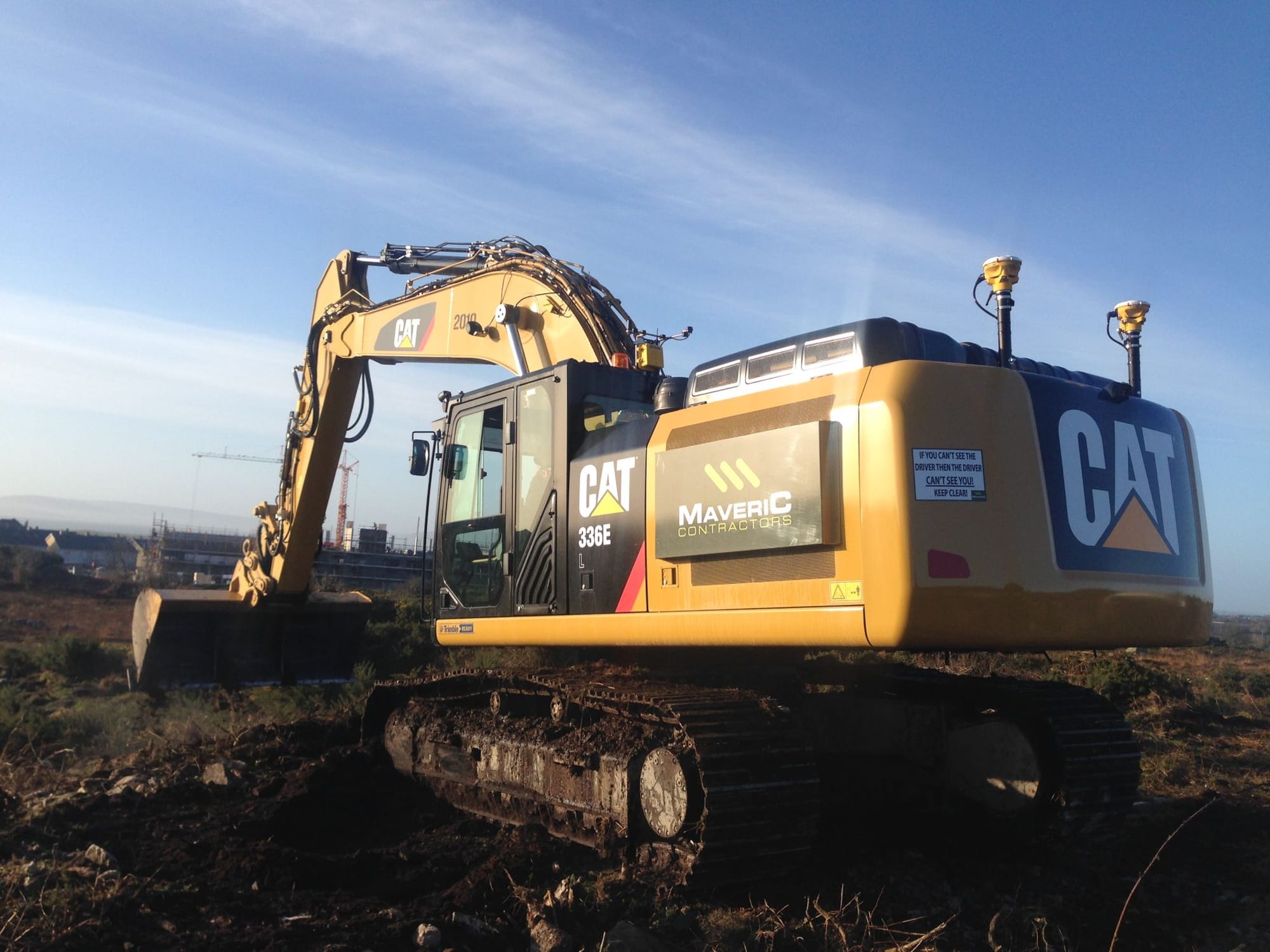
Maveric operates as a civil and enabling-works contractor and self-delivers that scope: our own crews and our own plant, rather than labour subcontracted on to others. That is a deliberate distinction, and the next section explains why it matters.
Self-delivery versus a management-and-subcontract model
Among construction companies in Ireland, two broad delivery models exist. In a management model, the contractor wins the work and then subcontracts most or all of it, managing the interfaces between trades. In a self-delivery model, the contractor performs the core works directly with its own workforce and equipment.
Self-delivery has real consequences for a client. Control over safety, quality and programme sits with the contractor doing the work, not at the end of a chain of subcontracts. Crews and plant can be moved between tasks and sites as the programme demands, rather than waiting on a subcontractor's availability. And accountability is unambiguous — there is no interface to dispute when something needs to be put right.
It is supported, in our case, by an in-house digital backbone — a proprietary construction ERP — and a field-technology stack including GPS machine control, ground-penetrating radar, vacuum excavation for safe digging around live services, AI proximity detection, fleet telematics and drone survey feeding building information modelling. The technology exists to make safe, traceable, right-first-time delivery repeatable on every site.
What to look for when appointing a contractor for critical infrastructure
Industrial and critical-infrastructure projects carry tolerances and consequences that ordinary commercial building does not. Live services, energised electrical environments, contaminated or unknown ground, and demanding programmes all raise the bar for who you appoint. When assessing building and civil engineering contractors in Ireland for this kind of work, weigh the following.
- Relevant sector experience — data centres, substations and grid, battery storage, renewables or semiconductors
- How much of the work is self-delivered versus subcontracted, and where accountability genuinely sits
- Certification to recognised management standards for safety, environment and quality
- A demonstrable safety culture, not just a policy document
- Capacity in crews and owned plant to hold the programme without relying on third parties
- Competence in ground risk — earthworks, dewatering, contaminated soil and safe digging around live services
- Digital traceability — quality records, as-builts and an audit trail from mobilisation to handover
- Financial and organisational stability to see a long programme through
Certifications, standards and safety
Certification is a useful baseline filter when comparing building companies in Ireland. Maveric runs one integrated management system across the group, aligned to ISO 45001 for occupational health and safety, ISO 14001 for environmental management and ISO 9001 for quality.
Certification alone is not the whole story. The more telling question is whether the standards are lived on site — whether method statements and risk assessments are signed off before work starts, whether near-misses are logged and closed out, and whether the same quality regime applies on every package. Our safety commitment is summarised in a single line that governs how every shift is planned: Home Safe. Every Shift. Every Day.
For projects in mainland Europe, additional local frameworks apply — German sites, for example, are delivered against German construction-site regulation. A capable European contractor should be fluent in the standards of each market it works in.
Choosing the right contractor for the project
Choosing a building contractor in Ireland is really a question of matching the contractor's model and depth to the demands of the project. For straightforward commercial or residential building, a management-led main contractor may be the right fit. For mission-critical infrastructure, where the ground, the services and the programme leave little margin, a self-delivering civil and enabling-works contractor offers a directness of control that a layered subcontract chain cannot.
Maveric delivers civil, structural and enabling works for data centres, grid and energy infrastructure across Ireland, Germany and Norway, with its own crews and plant and a single way of working on every site. If you are planning industrial or critical-infrastructure works, we are happy to talk through the civil scope and how we would approach it.
Frequently asked questions
What does a building contractor in Ireland actually do?
A building contractor takes responsibility for turning a design into a completed facility — planning and sequencing the works, mobilising labour, plant and materials, managing safety and quality, coordinating specialist trades, and handing over the finished works with a full record of what was built.
What is the difference between a main contractor and a civil engineering contractor?
A main contractor holds the overall contract with the client and is accountable for the whole works, often managing and coordinating subcontractors rather than self-performing. A civil engineering contractor delivers the civil, structural and enabling works — earthworks, ground risk, deep services, foundations and concrete — either as a major package or as a directly appointed contractor.
What does self-delivery mean, and why does it matter?
Self-delivery means the contractor performs the core works directly with its own workforce and plant rather than subcontracting them out. It gives the client clearer accountability, tighter control over safety, quality and programme, and more flexibility to move resources as the work demands.
What should I look for when appointing a contractor for a data centre or substation?
Look for relevant sector experience, how much of the work is genuinely self-delivered, certification to recognised safety, environmental and quality standards, a real safety culture, capacity in crews and owned plant, competence in ground and services risk, and full digital traceability from mobilisation to handover.
What certifications should a building contractor in Ireland hold?
A capable contractor for industrial work should run management systems aligned to recognised standards — typically ISO 45001 for safety, ISO 14001 for environment and ISO 9001 for quality. Maveric aligns its management systems to all three, run as one integrated system across the group.
Does Maveric work outside Ireland?
Yes. Maveric was founded in Galway in 2004 and operates across Ireland, Germany and Norway through three entities under one Irish parent, delivering civil, structural and enabling works for mission-critical infrastructure.